Reloading Subsonic .30-30 Win - Development of the load
2025 update: it’s been a few years since I wrote this article, and as I got more experience with reloading and long range shooting, I feel the need to say this: this series of articles presents a reloading process which is fine for this kind of shooting (i.e. recreational, fun shoot), but which lacks several steps and tools for a state of the art reloading. Be aware of this when reading this series of articles.
DISCLAIMER: the following content includes loading data not covered by currently published sources of tested data for the .30-30 Win cartridge. USE AT YOUR OWN RISK. I do not assume any liability for any damage or injury resulting from the use of this information.
Subsonic bullets and light loads can cause the bullet to get stuck in the barrel. ALWAYS CHECK YOUR BARREL IS CLEAR OF ANY BULLET/OBSTRUCTION BEFORE FIRING. A barrel obstructed with a stuck bullet or anything else can cause severe damage to the firearm and injuries to the user and people around.
I’ll explain here how I developed my subsonic .30-30 Win load, step by step.
Originally .30-30 Win was not made to be subsonic. The vast majority of .30-30 Win cartridges you will be able to find and buy will be supersonic, between 650 m/s (2133 fps) and 850 m/s (2789 fps). It is more than twice the velocity of subsonic cartridges (usually around 320 m/s, or 1050 fps).
Goal and concerns #
Like explained above, our goal is to have a bullet which doesn’t exceed 320 m/s (1050 fps). There will always be some fluctuation between bullets, but we’d like to be in the range of 300 m/s (985 fps) to 320 m/s (1050 fps).
However, we can’t simply decrease the amount of powder we put into the cartridge. There are three main concerns why this is not desirable.
Full ignition of the powder #
This is the most dangerous one. If we decrease enough the volume of powder into the cartridge, then when we chamber the cartridge (so the cartridge is horizontal) and the powder lays at the bottom of the cartridge, the level of the powder might be below the flash hole and the surface of powder exposed to ignition might be much bigger than normal. This is a problem because the primer will ignite much more powder at once than it should (or even all the powder at once), leading to a pressure spike. If the pressure spike is high enough, it could damage the gun or even cause severe injuries to the user.
This “full ignition” can be simulated in QuickLOAD by increasing the bullet weight to a very high mass (e.g. 170000 gr instead of 170 gr). This way, the program will make all the powder burn before the bullet moves at all, simulating that all the powder burnt at once. Of course, this test is only useful when the case fill is low and there is an actual risk of the powder burning all at once. If you do this test with 70%+ case fills, you will likely find that there is a big over-pressure, but since in this situation there is no chance of the powder burning all at once (because the case fill is high enough), it’s non-sense.
Thus, we have to be careful when decreasing the volume (volume is different from mass) of powder in a cartridge. Generally, we do not want to go below 60% of case fill. However, with faster burning powders, we can go lower, down to 40-30% of case fill. The good combination would be a powder with low density (i.e. high volume, because p = m/V) and high burning rate.
Poor ignition of the powder #
This one is the opposite of the first one. Let’s imagine now the powder is stacked towards the bullet, far away from the primer and the flash hole. The powder could ignite so bad that the pressure is too low. This could lead to a bullet stuck in the barrel, which is not great.
Inconsistent ignitions and erratic pressures #
Because the case fill is low, the powder will never be at the same place in the cartridge and will never burn the same: this will cause pressures and velocities to be very inconsistent from one bullet to another. Accuracy will greatly suffer from this, with the bullet sometimes dropping of several centimeters (up to 10-20 cm/4-8 in) even on short distances (50 m/55 yards). I tried my best to avoid this in my load development, but in this case it can’t be completely avoided and the rather low powder charge (56%) will be the factor limiting accuracy.
With manufactured subsonic .30-30 Win cartridges (from the french brand Sologne which, by the way, is the only one making subsonic .30-30 Win ammo in France), I measured differences of up to 100 m/s (328 fps) between bullets. Even if you do plinking and don’t shoot for precision, this will make you completely miss your target as it translates into a bullet drop of several centimeters. This is because they use about 0.43 g (6.64 gr) of Vectan Ba10 (read more on how I found this out on this page), which fills the case at only 38%!
Solution #
To avoid all these problems, we want to fill the most possible the case, but of course without causing an over-pressure, and also we want the bullet velocity to be in the 300 m/s (985 fps) to 320 m/s (1050 fps) range.
To fill the case, we have two options: use powder of course, or some filler material to keep the powder in place. I’m not a fan of the latter for several reasons:
- There will be more residues in the barrel.
- It can become useless if the cartridge is shaken too much and the powder somehow get over the filler material.
- It adds an extra step in the reloading process.
I started looking for a powder with low density (i.e. high volume, because p = m/V) and high burning rate.
The famous powder for this kind of use is TrailBoss, but unfortunately it is not available in Europe due to health concerns, so it was not an option for me.
I started to search for alternatives and I found a french magazine called Cibles published in 1998 which apparently used either:
- Vectan Ba10:
- Projectile: Hornady FP #3060 (170 gr)
- Charge weight: 0.48 g (7.41 gr)
- Or Vectan A1:
- Projectile: Hornady FP #3060 (170 gr)
- Charge weight: 0.50 g (7.72 gr)
While this seemed to be a viable (and practically tested) alternative, the case fills were still pretty low: 42% for the Vectan Ba10 and 36% for the Vectan A1. Plus, QuickLOAD estimated that such loads would result in much higher velocities (380 m/s – 1247 fps) than reported by the magazine.
Then, someone suggested me to try the Vihtavuori N32C “TinStar” powder. It is almost the same as TrailBoss, only the N32C has a slightly higher density (for a constant mass of powder, the volume of N32C will be smaller than the volume of TrailBoss). This is the best powder I could get my hands on for this specific application.
Consumables: what to choose? #
Powder: Vihtavuori N32C “TinStar” (US: $75/kg, FR: €96/kg) #
Everything is already explained above for the powder: we’ll need a jar of Vihtavuori N32C.
Bullets: Hornady FP #3060 .308 170 gr (US: $30/100, FR: €36/100) #
To achieve subsonic velocity with .30-30 Win, a 170 gr (11 g) bullet is handy. While several different 170 gr bullets can work, keep in mind there are other factors than mass to watch out for:
- Bullet shape: it will change the aerodynamics of the bullet but also the internal volume of the cartridge (and so the pressure too).
- Bullet material/coating: it will change the terminal ballistics and shot start pressure.
- Bullet tip: when using a tubular magazine, we want a flat point or round nose tip to avoid striking the next cartridge.
I made all my tests with a 170 gr bullet, but perhaps a 220 gr bullet would be even better: indeed, it would require more powder, so the case fill would be higher, so the powder would burn more consistently. However, it would change the pressure, the stability factor of the bullet, and other parameters, so it requires to rework the load completely. This is on my to-do list!
Empty cases: Sellier & Bellot unprimered .30-30 Win cartridge cases (US: $65/100, FR: €51/100) #
There are several brands for unprimered cartridge cases (Sellier & Bellot, Starline, Federal, etc.), and any of them will work. Personally I’m using Sellier & Bellot and I’m happy with it so far.
Primers: CCI Large Rifle Primers (US: $4, FR: €6/100) #
Again, there are many brands for the primers. Any of them will work as long as they are Large Rifle primers. I tried the Winchester Large Rifle primers, but I believe they are a little bit bigger (or perhaps have a different shape?) than the CCI primers, and they were hard to seat deep enough. That’s why I switched to CCI primers.
Case Lube: Lyman Case Lube (US: $7, FR: €8) #
Lube is absolutely necessary to full-length resize your rifle cases. There are many brands, most will work fine.
Tip: do NOT put lube on the case neck, only around the case mouth and, if necessary, around the middle of the case body. Excessive lubrication can cause dents to appear on the case neck.
Total cartridge cost price #
Knowing the charge weight is 0.57 g/8.8 gr (see below), the total cartridge cost price is:
- Powder: $0,04/cartridge or €0,05/cartridge
- Bullet: $0,30/cartridge or €0,36/cartridge
- Empty case: $0,65/cartridge or €0,51/cartridge but these are reusable many times, so let’s say $0,13/cartridge or €0,10/cartridge if reusing the cases 5 times
- Primer: $0,04/cartridge or €0,06/cartridge
- Total: $0,51/cartridge or €0,57/cartridge (if reusing the cases 5 times)
Development and testing #
First, I simulated different loads with QuickLOAD. I made sure to do the “full ignition” pressure test in QuickLOAD (like described above, by increasing the bullet weight to something very high). It suggested that to achieve a bullet velocity of 320 m/s (1050 fps) in a 24″ barrel (610 mm), the right mass of N32C was 0.42 g (6.48 gr). I loaded my first cartridges with 0.42 g (6.48 gr) of N32C and measured the bullet velocity with my chronograph:
- Bullet 1: 228 m/s (748 fps)
- Bullet 2: 247 m/s (810 fps)
- Bullet 3: 209 m/s (686 fps)
- Bullet 4: 218 m/s (715 fps)
- Average: 225 m/s (738 fps)
- Standard deviation: 14 m/s (46 fps)
As we can see, it is way under the desired velocity of 320 m/s (1050 fps). Usually, QuickLOAD is pretty accurate, but here we have to keep in mind we’re working with light loads, and a substantial amount of powder doesn’t burn because of it. That’s probably why QuickLOAD gives bad results. I then tried with 0.51 g (7.87 gr) of N32C:
- Bullet 1: 245 m/s (804 fps)
- Bullet 2: 285 m/s (935 fps)
- Bullet 3: 280 m/s (919 fps)
- Bullet 4: 259 m/s (850 fps)
- Bullet 5: 278 m/s (912 fps)
- Average: 269 m/s (883 fps)
- Standard deviation: 15 m/s (49 fps)
It’s already better, but still not quite what we want. My next iteration was 0.56 g (8.64 gr) of N32C:
- Bullet 1: 310 m/s (1017 fps)
- Bullet 2: 313 m/s (1027 fps)
- Bullet 3: 305 m/s (1001 fps)
- Bullet 4: 306 m/s (1004 fps)
- Bullet 5: 315 m/s (1034 fps)
- Average: 310 m/s (1017 fps)
- Standard deviation: 3.9 m/s (13 fps)
We’re getting there! Finally, I tried with 0.57 g (8.8 gr) of N32C, and you guessed it, I reached the 320 m/s (1050 fps)! The case fill is about 56%. The velocities between bullets are pretty consistent, usually between 300 m/s (985 fps) and 320 m/s (1050 fps). However, it sometimes happens (1 out of 50 cartridges?) that the bullet goes very low and crash sideways on the target. I’m unsure why, but it might be because of a bad/inconsistent powder burn.
Keep in mind that, while these cartridges will be good enough to do plinking/target shooting at distances up to 100-150 meters (maybe a little bit more?), don’t expect an outstanding accuracy: like explained many times, the low case fill results in inconsistent burns and thus accuracy isn’t the best. Plus, we have a rather low initial velocity and energy, which won’t allow us to shoot accurately at greater distances.
Still, these handloaded subsonic cartridges are much (much!) better than the ones I used to buy from the manufacturer Sologne in France. Indeed, the Sologne cartridges are really inconsistent: I measured velocities from 170 m/s to 300 m/s, which translates to bullets hitting the ground before reaching the target in some cases! Pretty bad. I believe the goal is achieved!
Again, be very careful with all these numbers. It’s not because it worked for me that it will work for you. You probably have a different barrel length, different cases with different volumes, maybe a different seating depth… Do NOT try with 0.57 g (8.8 gr) right away. I highly recommend you to start at 0.42 g (6.48 gr) like I did and work the load up. Also make sure to double-check my conversions between grams and grains.
Warning: powder residues #
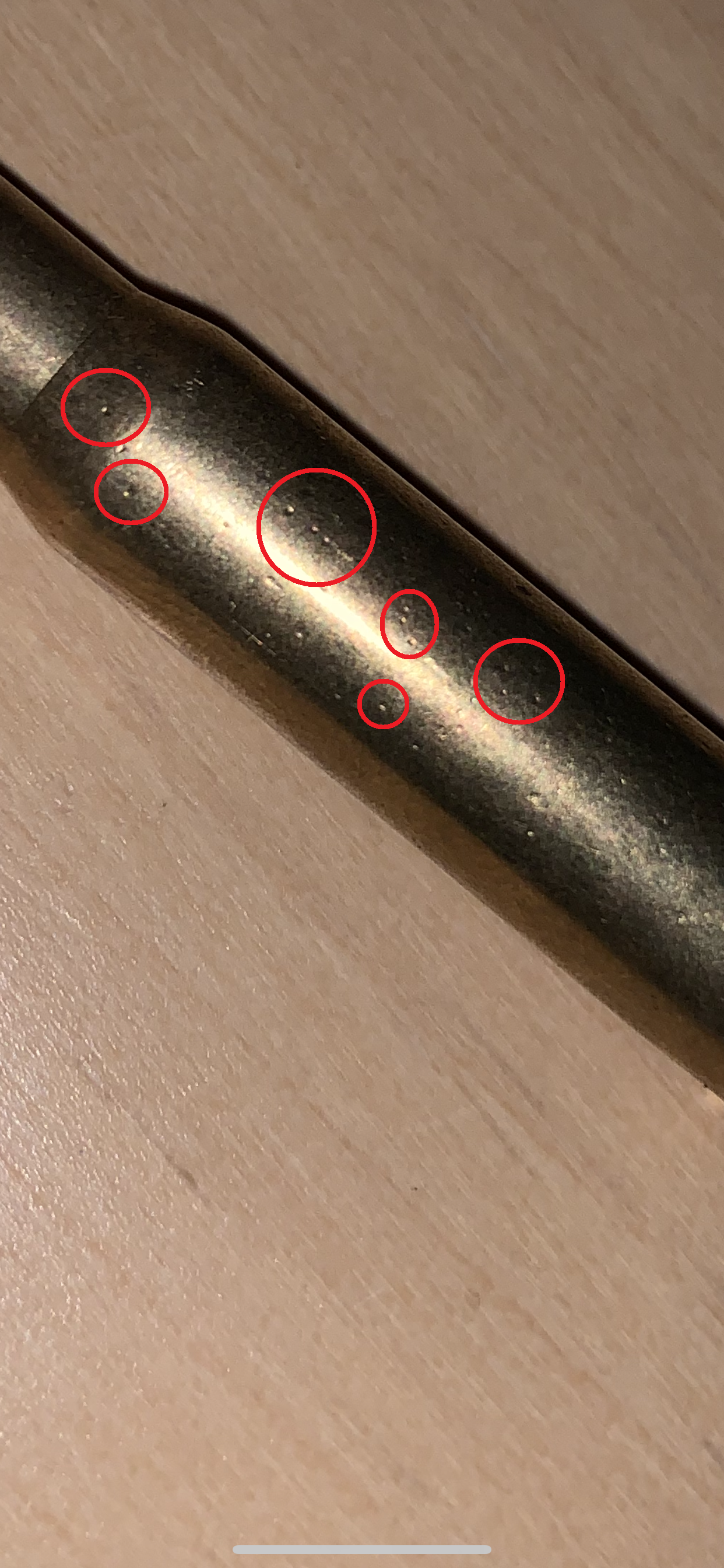
As already explained, with these light loads, a substantial amount of powder doesn’t burn. Some of this powder will go directly into your chamber and barrel (see this picture I took: due to powder residues in the chamber and barrel, this case was engraved by small unburnt powder grains, resulting in a harder extraction from the chamber. It is best to discard such cases). I highly recommend you to clean your rifle after each use, or you will run into troubles like I did.
Read also: