Reloading Subsonic .30-30 Win - The tools you need
2025 update: it’s been a few years since I wrote this article, and as I got more experience with reloading and long range shooting, I feel the need to say this: this series of articles presents a reloading process which is fine for this kind of shooting (i.e. recreational, fun shoot), but which lacks several steps and tools for a state of the art reloading. Be aware of this when reading this series of articles.
I’ll cover here all the tools needed to make .30-30 Win cartridges. I’ll split them in three categories:
- Mandatory: you won’t be able to make cartridges without this tool.
- Highly recommended: not using this tool will make the reloading process much more tedious and/or error-prone and/or you will waste consumables.
- Optional: it is a comfort tool. It will make your life easier and will save you some time.
The goal here is to have a big picture, present the tools and briefly explain what they’re used for. Make sure to read the Reloading cycle page to understand how they’re used together and their role in the reloading process as a whole.
For practical use (how to set up the tools and how to use them in practice), please refer to other tutorials (YouTube is a great place for this!).
Also keep in mind this list of tools is for reloading .30-30 Win, but the tools are pretty much the same for all rifle calibers (there are more differences with handgun calibers) and you can adapt them easily if you wish to reload another caliber.
The prices in $ are the retail prices in the US, and the prices in € are the retail prices in France where I live (and as you will see, there is quite a difference). All prices are rounded to the closest $5/€5.
Press: Lee Classic Turret Press (mandatory, US: $165, FR: €190) #
As you can imagine, this is the one you can’t skip. A press is merely an arm with a ram you raise and lower, depending on what you want to do. The power and versatility of the press comes from its dies and other tools you can mount on it. You have lots of different dies, each serving one specific purpose (e.g. seat the bullet, resize the case, etc.). Also note most dies are for a specific caliber: if you get a resizing die for example, you will need to get it for the specific caliber you’re reloading, because of course a .30-30 Win case is not the same as a .308 Winchester case, even though they both shoot .308 in (7,82 mm) bullets. Finally, depending on the caliber you’re reloading and your personal use case, you won’t need the same dies: for example, you might want to crimp .30-30 Win bullets because they go into a tubular magazine (most likely) and could move with the recoil of the gun when shooting, but you probably don’t need to crimp .308 Winchester bullets if you use them in a bolt action rifle where there is very little movement in the magazine (perhaps you don’t even use a magazine and put the bullet directly into the chamber!).
There are many brands and each brand offers many models. To choose my press, I evaluated three criteria:
- Availability: is it available in my country, can I easily find retailers selling it, but also selling all the dies and tools I will need?
- Community: is it widely used? It is always better to have “standard” tools so you can search online for tutorials and easily ask for help when needed.
- Flexibility: can I do everything I need with it? Does it work for all calibers I want to reload?
The Lee Classic Turret Press checks all the boxes. Also, this press can have up to 4 dies mounted at the same time: it is very convenient! With a single stage press, at each step of your reloading process, you need to unscrew the previous die and screw the next one… cumbersome!
Fortunately, most of the dies and tools of one brand (e.g. Lee) will also work on presses from another brand (e.g. RCBS). Make sure to check before buying, but usually, it’s standard, and it’s compatible!
Finally, note you will need to mount this press somewhere, and it does NOT come with any screw or bench. The bench needs to be stable and rigid, otherwise you might have strange problems such as primers not seating deep enough (if you use the “Lee Lever Primer System”). I spent hours figuring this out!
Die Set: Lee 30/30 Ultimate Die Set (mandatory, US: $65, FR: €80) #
You can’t do much with the press alone. You need to buy the proper die set for the caliber you want to reload: in our case, the Lee 30/30 Ultimate Die Set.
Here is the order in which I use them and what they are for:
- Full Length Resizing Die: to resize the brass to factory dimensions (when shooting, the case gets deformed because of the pressure).
- Long Charging Die (required if using the Lee Auto-Drum Powder Measure presented below, US: $25, FR: €30) which is NOT included in the Ultimate Die Set: to drop the powder charge into the case. Note: this is not mandatory, you could decide to measure and drop the powder by hand instead of using the Auto-Drum Powder Measure shown below.
- Bullet Seating Die: to seat the bullet at the proper depth.
- Factory Crimp Die: to crimp the bullet.
High Precision Electronic Scale (mandatory, US: $40-50, FR: €40-50) #
You will need a scale for weighting the powder charge, but also to weight everything else and make sure the final cartridge weight is as expected (if it’s too heavy, it might mean you double charged the cartridge for example, which would be very dangerous). Any high precision electronic scale will do (e.g. Hornady G2-1500 Electronic Scale).
Note you could also use a beam scale such as the Lee Safety Powder Scale.
Caliper (mandatory, US: $30-40, FR: €30-40) #
Like the scale, you will use the caliper to measure about everything: case length, neck diameter, primer pocket depth, etc. Any digital caliper will do (e.g. Frankford Arsenal Electronic Caliper).
Powder Measure: Lee Auto-Drum Powder Measure (highly recommended, US: $55, FR: €65) #
As its name suggest, this is used to measure and drop a charge of powder into the case by just rising the ram with the case to the powder measure. It has to be set up first by trial and error method to drop the exact charge of powder you want. It is not mandatory, but highly recommended: if you don’t have a powder measure (this one or any other), you will have to measure and drop the powder by hand (or with a powder tickler) for each cartridge: it would be very time-consuming and also error-prone (and you don’t want to make a mistake on the powder charge!).
If you go for this powder measure, don’t forget you also need the Lee Charging Die Kit (US: $25, FR: €30).
Powder Funnel: Lyman E-Zee Powder Funnel (highly recommended, US: $5, FR: €10) #
It is a very basic tool, perhaps you already own one, but you will for sure need it at some point. I particularly like the Lyman one because it will adapt to all the cases from .22 to .50 calibers.
Case Trimmer: Lyman AccuTrimmer (highly recommended, US: $75, FR: €85) #
Every time you will shoot a bullet, the case will slightly expand. This tool is used to trim the case back to its factory length. If you don’t trim your cases, don’t expect to reuse them several times. If you plan to always buy new brass then it’s fine, but otherwise this tool is mandatory.
Also keep in mind even factory new cases won’t have the same length: they will likely be under the maximum length required for the case (which is 51.80mm for .30-30 Win), but some will be 51.75 mm, others will be 51.70 mm, etc. Consistency is accuracy: you want your cases to be as consistent as possible, so it is a good idea to trim factory new cases if they don’t have the same length (and they won’t). However, while this last sentence is true and people do it to get maximum accuracy when shooting long range, the limiting accuracy factor for us probably won’t be the case length: it will be the low powder charge causing inconsistent burns (see the Development of the load page for more details).
Case Preparation Kit: Lyman “Universal” Case Prep Accessory Tool Set (highly recommended, US: $80, FR: €90) #
This kit includes many tools:
- Small and Large Primer Pocket Cleaners: to clean the primer pocket as the name suggests, if there is anything stuck there.
- Small and Large Primer Pocket Uniformer Tools: to resize the primer pocket depth (not width) to factory dimensions.
- Small and Large Primer Pocket Reamers: to remove military crimps at the mouth of the primer pocket. This is needed only on some specific cartridges with military crimps (these tools are not needed for .30-30 Win).
- Outside deburring tool: to remove sharp edges and burrs from the case mouth after trimming it.
- Inside chamfer tool: to remove sharp edges and burrs from the case mouth after trimming it.
If you trim your cases, it is better to have the outside deburring/inside chamfer tools to do proper work. If you want to reuse your cases, you will need the large primer pocket cleaner and large primer pocket uniformer tool at some point (although you might not use these tools every time for every case). You won’t need the primer pocket reamers for .30-30 Win.
Chronograph: Caldwell Ballistic Precision Chronograph (highly recommended, US: $105, FR: €160) #
Once you assembled a few cartridges, you will need to check if your powder charge produces the expected velocity. The load data you can find in reloading manuals or given by internal ballistic simulators such as QuickLOAD is only an estimation of the velocity. It depends on many factors (including the barrel length) and so the only way to know the actual velocity for your firearm is to shoot the bullet and measure its speed with a chronograph.
Some might say this is not needed and you can trust the load data which come with your powder, but:
- In our case, you probably won’t find any load data for subsonic .30-30 Win as it is a pretty uncommon thing.
- As explained above, the velocity WILL be different from the one in the load data anyway because your barrel length is different, you apply a different crimp on the bullet, etc.
- Verifying is always better than assuming.
Hand Priming Tool: Lee New Auto Prime (optional, US: $30, FR: €35) #
The name of the tool is pretty explicit: this is used to seat the primer into the primer pocket of the case. Note you will need different shell holders than the ones used by the press: Lee Priming Tool Shell Holder Set (US: $25, FR: €25).
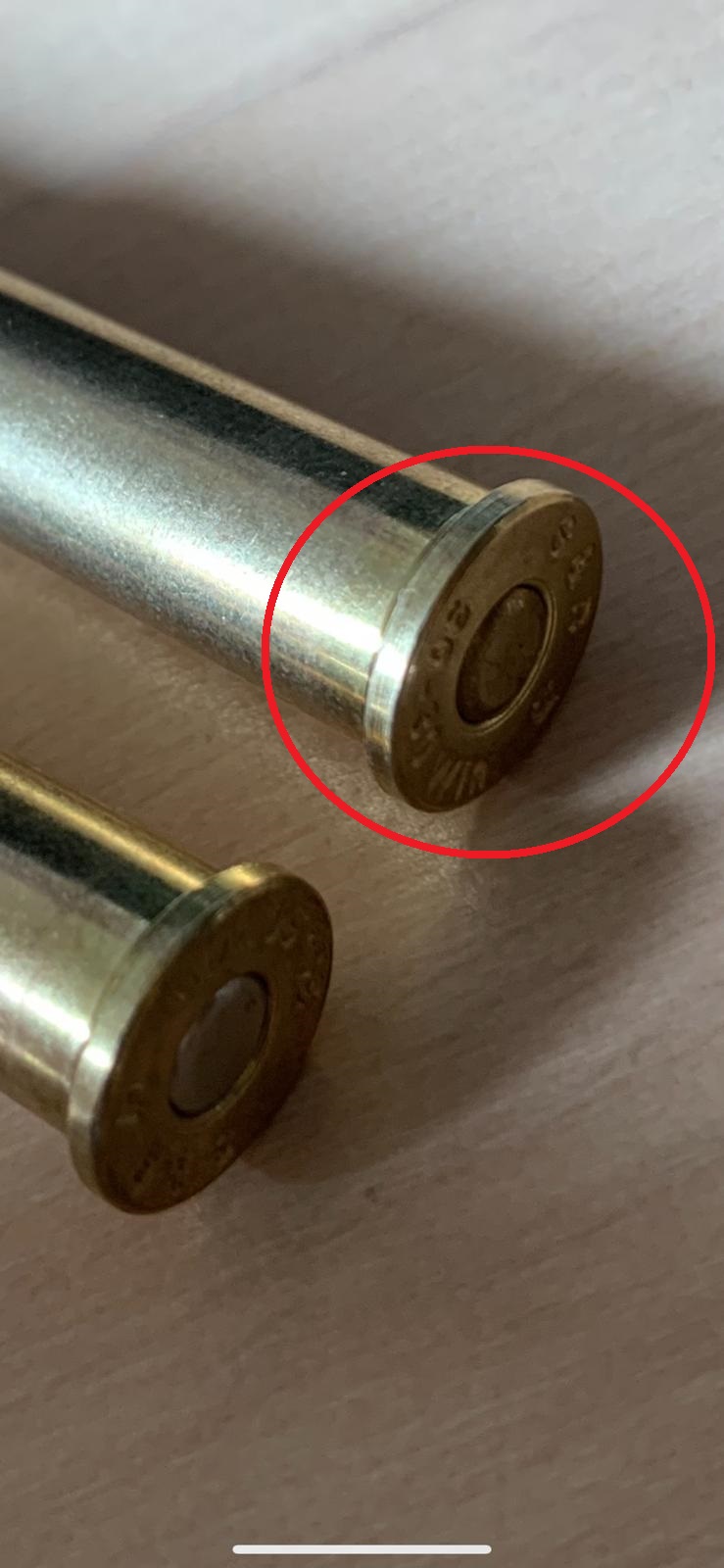
This is optional because the Lee Classic Turret Press comes with the “Lee Lever Primer System”. Whichever tool you choose, make sure the primer is seated deep enough into the primer pocket so there is no bump below the case (see this picture for an example of what NOT to do: we can see the primer of the cartridge on the top/right is not seated deep enough. In comparison, the cartridge on the bottom/left has a correctly seated primer). An inconsistent or bad primer seating depth is bad for several reasons.
Hand DePriming Tool: Frankford Arsenal Hand DePrimer (optional, US: $55, FR: €60) #
After the hand priming tool, here comes the hand DEpriming tool! You guessed it: this is used to remove the primer from fired cartridges.
This is optional because the Full Length Resizing Die will also deprime the case, but then it means either:
- You’re resizing dirty cases (and so you will foul your dies/tools).
- You’re washing your cases with the primer still on.
In either case, it is not optimal.
Another option would be the Lee Decapping Die, which deprimes the case without resizing it, but then the problem is we only have 4 slots on our turret press and they are already all taken.
Wet Tumbler: Frankford Arsenal Rotary Tumbler Lite (optional, US: $150, FR: €200) #
There are three main ways to clean your brass. I’m part of the people who think wet tumblers are the best method for case cleaning. Wet tumblers will usually achieve better cleaning, but they will also make your brass shiny! To use a wet tumbler, you put the cases in the jar with some Stainless Steel Tumbling Media (US: $25, FR: €40), fill it with water, and finally add some dish washing liquid and citric acid!
The other methods are ultrasonic cleaners and vibratory cleaners.
I wrote it down as optional because you may choose not to clean your brass, but then eventually you’ll need to buy new brass (sooner) and you will soil your dies with dirty cases. So you can skip cleaning, but it is in my opinion very suboptimal.
Media Separator: Frankford Arsenal Wet/Dry Media Separator (optional, US: $50, FR: €50) #
Whether you use a dry or wet tumbler, you will use a media and you will need to separate it from the cases when they are cleaned. Of course, you can do it by hand, but perhaps you want to save some time with this tool.
Case Dryer: Lyman Cyclone Case Dryer (optional, US: $70, FR: €95) #
If you use a wet tumbler, you will need to dry your cases. You want to make sure there is not a single drop of water left in them because it could contaminate the powder and cause a malfunction (bad ignition, bullet stuck in the barrel, etc.). You can use a towel and leave them to dry overnight, or save some time with this case dryer.
Inertia Bullet Puller: Lyman Magnum Inertia Bullet Puller (optional, US: $25, FR: €30) #
This tool is used to safely disassemble a bullet (i.e. extract the bullet and retrieve the powder). This is of course optional, but you will be glad to have it when you’ve seated a bullet too deep into the case and can’t get it out.
Lube pad: Lyman Complete Case Lube Kit (optional, US: $25, FR: €25) #
You get three items in this kit:
- Lube pad: to avoid having to spread the lube with your fingers. This will also save you some lube over time because you won’t waste any on your fingers by wiping it regularly.
- Three neck brushes (sizes S, M, L) and a handle: to clean the inside of your case necks.
- Lube: to full-length resize your brass.
While the lube pad/brushes are optional, the lube is absolutely required (this is discussed here and here).
Powder Trickler: Frankford Arsenal Powder Trickler (optional, US: $25, FR: €25) #
This is very useful to fill up the last few grains of powder in a case. It is nice to have, but you can definitely do without, especially because we won’t be aiming for extreme accuracy with our subsonic .30-30 Win cartridges (like already explained above, the limiting accuracy factor will be, by far, the low powder charge).
Plastic Ammo Boxes (optional, US: $5-10, FR: €5-10) #
It’s cheap and it really helps keeping things organized and preventing mistakes: one box for empty cases, one for finished cartridges, one to transport them to the range… what you will do with the boxes will heavily depend on your process, but you will need them for sure!
Internal Ballistics Predictor: QuickLOAD (optional, US: $155, FR: €140) #
QuickLOAD is an internal ballistics predictor software. Basically, you input into the program a ton of measurements (case length, bullet weight, powder, barrel length, and many, many other settings) and it gives you nice curves of the chamber pressure and bullet velocity. Of course, this is quite a simplification and this program has in reality much more features and it can get quite complex. The idea is that you try your load into QuickLOAD before trying it in reality. It will probably save you some time and money. And maybe it will even prevent you from blowing up your gun!
The downsides:
- It is only a simulation, so the results in practice can differ greatly. Still, it works pretty well most of the time given that you input correct and accurate data. In my case, when doing simulations for subsonic .30-30 Win cartridges, it was way off the reality (make sure to read the Development of the load page to learn more about my load development).
- For some reason, you cannot download this program: the seller has to ship the installation CD-ROM to you by mail and you must install the program with the CD-ROM (which means you need a CD-ROM reader). It’s not a joke! It is probably the last program on planet earth to be distributed like this in 2020, but there is no other way to get it at this time.
Until recently, there was no alternative to QuickLOAD. Now, there is Gordon’s Reloading Tool. Pro: it is free! Con: it’s nowhere near QuickLOAD in terms of features, and it’s lacking the characteristics of a lot of powders, which means you simply can’t use the tool with many powders. The developers already put some serious work into this program, but in my opinion it is not ready (yet) for practical use at this time (2020).
Cartridge Gauge: Hornady Cartridge Gauge for .30-30 Win (optional, US: $20, FR: €30) #
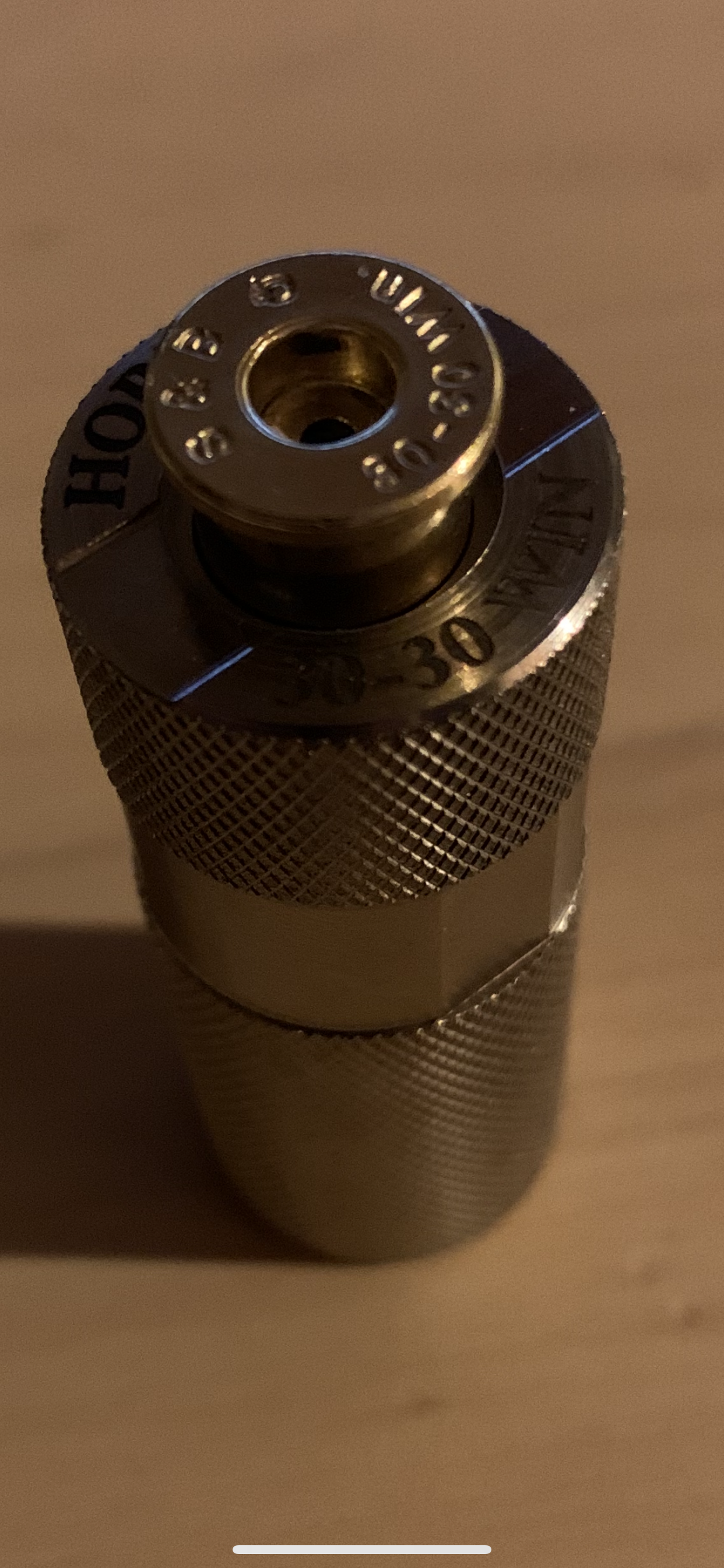
This can be useful to quickly and safely check if a cartridge respects the standard required dimensions: just drop the cartridge into the gauge, and check if it fits correctly. For example, see this picture I took for a cartridge which doesn’t fit into the gauge and needs to be resized.
Bullet Comparator: Hornady Bullet Comparator (optional, US: $35, FR: €40) #
From Hornady’s website: “Measuring cartridge lengths across the bullet tips is not a reliable method. The bullet comparator measures rounds from the ogive to provide consistent, precise measurements.”.
It attaches to the blade of a caliper and comes with several inserts for different calibers.
Headspace Comparator: Hornady Headspace Comparator (optional, US: $40, FR €50) #
From Hornady’s website: “The gauge measures variations in brass before and after firing or re-sizing. It allows for headspace comparison between fire-formed brass and re-sized brass.”.
You’d generally use this tool when you become serious about reloading and accuracy to make sure your cases are as similar as possible. Again in our case (subsonic .30-30 Win) it doesn’t make a lot of sense, but you can still get it to see the effect of firing or resizing on a brass.
Conclusion #
- Mandatory tools total: US: $320, FR: €360
- Highly recommended tools total: US: $345, FR: €440
- Optional tools total: US: $740, FR: €855
- Total: US: $1405, FR: €1655
As you can see, getting into reloading can be quite expensive. In theory, you can start with only the “mandatory” tools, but trust me: you will end up buying the “highly recommended” ones because if you don’t have them, it will be a pain. Also keep in mind this does not include the consumables (empty cases, bullets, powder, primers, case lube) and delivery fees (if you order online).
In my case (where a box of 20 subsonic .30-30 Win cartridges costs €75), reloading will pay off after about 28 boxes (560 bullets). How I got this number? 1655 / (75 – 15). 15 being the estimated cost of making 20 bullets when reloading, given I already have the empty cases (so I’m counting only bullets, powder and primers). With this situation, it’s paying off quickly, but if you plan on reloading more common cartridges, let’s say your usual .308 Win, you will probably need to make thousands of cartridges to make it profitable.
To sum it up: don’t reload for saving money, reload because it is fun and because you can get better performance with cartridges tailored to your needs and firearms.
Read also: